Your Brand Now Has Two Reputations: Why ORM Matters in the Age of AI Search
Social media's post-COVID boom changed how customers judge brands. Cerebrate Solutions' Athikur Rehman Ansari on ORM in the age of AI search.
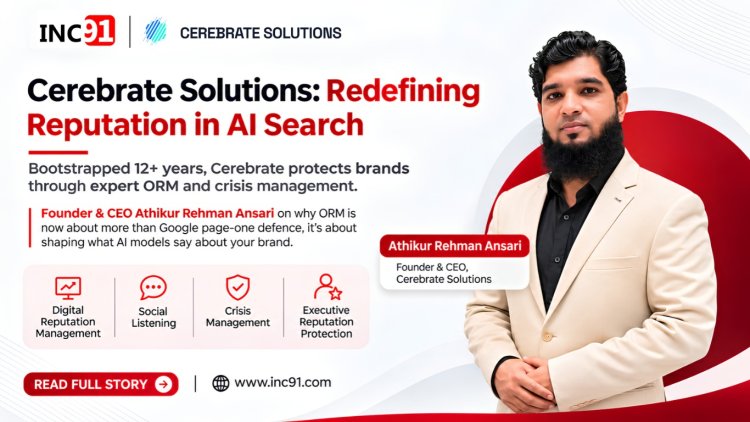
Cerebrate Solutions Founder & CEO Athikur Rehman Ansari on why online reputation management (ORM) is shifting from Google page-one defence to shaping what AI models say about a brand, and why most companies still treat it as a line item, not a specialism.
Online reputation management (ORM) has moved from a back-office afterthought to a boardroom priority, and few founders have watched that shift as closely as Athikur Rehman Ansari. For more than twelve years, the Founder & CEO of Cerebrate Solutions has run an independent, bootstrapped ORM agency on one conviction: reputation deserves to be treated as its own discipline, not a sub-function of digital marketing. As social media and AI search reshape how customers discover and judge brands, that conviction looks increasingly well founded.
How COVID-19 Changed Where Customers Talk About Brands
When lockdowns pushed shopping, banking, learning and entertainment online, social media platforms stopped being places for casual updates and became the place where consumers discovered products, compared options and voiced complaints. Platforms such as X, Reddit, Quora and LinkedIn, together with review sites like Trustpilot and Glassdoor and app-store ratings, filled with first-hand customer experiences.
The habit did not end with the pandemic. Post-COVID, customers routinely research a brand before they buy, read what other customers say, and escalate publicly when a service falls short. Ansari saw this early. As the world moved online, he says, consumers used the internet to voice their concerns and expectations more than ever, and a wave of new-age brands emerged into a market where every interaction could become a public review.
From Brand Messaging to Public Perception
Before this shift, a brand largely controlled its story through its website, advertising and PR. Today the story is co-written by customers, employees, journalists and community members, and much of it lives on platforms the brand does not own. A frustrated customer's thread, a run of one-star app-store reviews or an anonymous employer review can shape perception long before a prospect reaches the company's own page.
Search engines surface these conversations, and AI assistants increasingly draw on them, so sentiment around a brand now travels further and lasts longer than it once did. Before engaging a brand today, customers typically check:
- Google reviews and the brand's Google Business Profile
- Discussions on Reddit and Quora
- Trustpilot ratings and app-store reviews
- Employer reviews on Glassdoor
- What AI assistants such as ChatGPT, Gemini and Claude say when asked about the brand
Why ORM Became Central to Brand Growth
For many marketing agencies, this consumer conversation was, in Ansari's words, "not a glamorous department," and it went largely ignored. Yet it is the most honest, unfiltered feedback a brand will ever receive. It influences conversion, hiring, investor confidence and, in regulated sectors, compliance exposure.
That is the gap Cerebrate was built to fill. Rather than treating listening and response as a campaign add-on, the agency positions social listening, crisis detection and reputation risk management as infrastructure, staffed by specialists who handle crises for a living. In a market where perception is formed in public, ORM is no longer supporting the growth strategy. It decides whether that strategy is believed.
Building a Category Most Agencies Ignored
Ansari’s 21-year career spans customer service, call centres and online reputation management. Before founding Cerebrate, he spent four years building an independent ORM department inside a social media agency, a unit that grew to 20+ brand accounts and roughly 50 team members serving US and Australian clients. He founded Cerebrate after recognising a structural gap: India's digital marketing agencies were overwhelmingly focused on building marketing infrastructure, leaving ORM and social listening underserved.
Twelve-plus years later, Cerebrate remains bootstrapped and independent, with roughly 60% of its client portfolio concentrated in BFSI, a sector where reputation and regulatory exposure intersect directly.
The Argument: AI Reputation Can't Simply Be Bought
Ansari's recent commentary centres on a distinction he considers under-appreciated: paid visibility versus AI reputation. As platforms like ChatGPT introduce advertising and consumers increasingly ask AI assistants for recommendations rather than typing search queries, he argues that two separate battles are emerging: competing for visibility when a customer shows commercial intent, and shaping what an AI system says when asked about a brand unprompted.
"The second one cannot simply be bought," he says. "It has to be earned through the digital footprint a brand has built across reviews, publications, communities, forums and customer conversations."
He points to Reddit's escalating fight against coordinated fake engagement, with the platform reportedly intercepting roughly 25,000 new spammy posts and comments and revoking nearly 2 million inauthentic votes daily, as evidence that AI-trusted platforms are becoming a genuine reputation battleground. "The next reputation battle won't be fought on Google Search," Ansari says. "It will be fought inside the conversations AI trusts."
The Case Against Treating ORM as a Marketing Line Item
A recurring theme in Ansari's commentary is that organisations misallocate ORM responsibility, either handing it to internal teams without crisis methodology or folding it into a marketing agency's mandate, where it is treated as an adjacent skill. He puts it bluntly: "That's like treating chest pain with a dermatologist, qualified doctor but a wrong specialist."
What Cerebrate Delivers
The agency's core services span Digital Reputation Management, Social Listening and Competitor Analysis, Crisis Management, and Executive/Founder Reputation Protection. They are supported by 24/7 monitoring across Google, LinkedIn, X, Reddit, Quora, Trustpilot, Glassdoor and app-store ecosystems, with a 15-minute crisis response SLA. Extended services include Google Business Profile management and Wikipedia page oversight for policy-compliant, accurate brand representation.
The Business Case for Reputation Infrastructure
Ansari ties reputation management to enterprise financial outcomes, arguing that leadership changes and the public narrative around them can affect investor confidence. His framing: detection and containment do not prevent every crisis, but they can shorten a company’s response window from hours to minutes. In his view, early containment helps reduce the risk that a temporary setback becomes prolonged reputational damage.
Looking Ahead: Global Expansion
Ansari's stated five-year plan is international expansion, building on Cerebrate's footprint across India, the Middle East, the UK, the US and Australia to establish offices in multiple global cities while bringing international client business into India. His guidance for founders building in underserved categories: identify the gap competitors consider unglamorous, and commit to building the specialism properly rather than treating it as an add-on service.
Frequently Asked Questions About Online Reputation Management
What is online reputation management (ORM)?
ORM is the practice of monitoring, protecting and shaping how a brand is perceived across search engines, social media, review platforms and, increasingly, AI assistants. It combines social listening, crisis management and reputation risk management.
How did COVID-19 change brand perception online?
As daily life moved online, social media and review platforms became the default place where consumers discovered, compared and criticised brands. That behaviour has persisted, so a brand's reputation is now shaped largely by conversations it does not control.
What is AI reputation?
AI reputation is what AI assistants say about a brand when asked. According to Ansari, it cannot simply be bought. It is earned through the reviews, publications, communities, forums and customer conversations a brand has built over time.
Why should brands hire a specialist ORM agency?
Ansari argues that ORM needs crisis-handling methodology and platform-level expertise that general marketing teams rarely have. A specialist agency treats detection and response as infrastructure rather than as a campaign.
About Athikur Rehman Ansari
Founder & CEO, Cerebrate Solutions Pvt. Ltd. Website | LinkedIn | Instagram
Featured by INC91.
What's Your Reaction?