From Outsourcing to Capability Partner: The Strategic Pivot Behind SSGServ's Global Capability Center (GCC) Model
SSGServ Founder & CEO Faizan Kanth explains why the company deliberately repositioned itself away from traditional BPO and toward a Global Capability Center (GCC) model and why that distinction matters for enterprise clients evaluating global delivery partners.
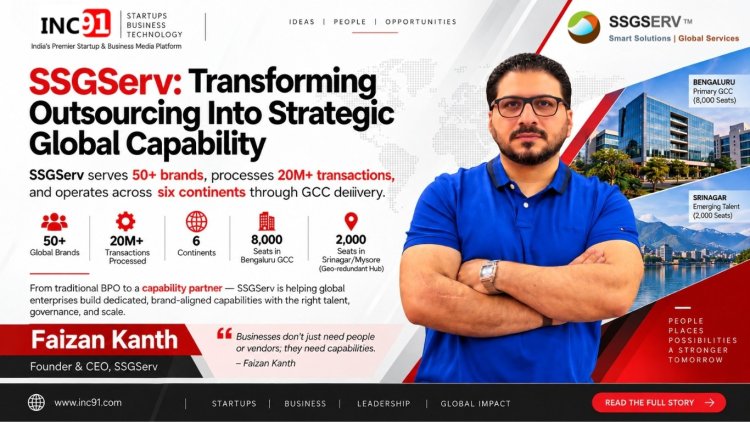
The language of global delivery is shifting. Enterprises no longer ask outsourcing vendors "how many people can you provide" they ask "what capability can you help us build." SSGServ Founder & CEO Faizan Kanth built his company's strategy around that exact shift, and it's reshaping how the firm positions itself against both legacy BPOs and full captive-center builds.
The Strategic Gap Between Outsourcing and Captive Centers
Kanth, an IIM Bangalore alumnus and Lean Six Sigma Black Belt with a career spanning operations, strategy, technology, and international markets across EMEA, APAC, and North America, founded SSGServ in 2015 around a specific market observation: enterprises expanding internationally were stuck choosing between two imperfect models. Traditional outsourcing optimised for cost, headcount, and transaction volume but offered limited visibility or brand alignment. Building a fully captive operation offered control but demanded capital, time, and management bandwidth most organisations couldn't justify for a single function.
"A company should be able to build a dedicated capability with its own standards, governance, culture and processes without necessarily having to build every piece of infrastructure from scratch," Kanth says. That gap is precisely where SSGServ's GCC positioning sits.
Why the GCC Model Changes the Client Conversation
According to Kanth, the structural difference between traditional outsourcing and the GCC model isn't cosmetic it changes what clients are actually buying. Traditional outsourcing is transactional and task-oriented, with vendor-managed talent, high turnover, and success measured against cost arbitrage and SLA compliance. SSGServ's GCC model, by contrast, positions the delivery team as an integrated extension of the client's own brand with direct ownership of talent and IP, shared culture and mission, and success measured against value creation and specialised expertise rather than cost alone.
"The GCC model changes the conversation from 'how many people can you provide?' to 'what capability can you help us build?'" Kanth explains. "We believe the future of global services will be less about simply moving work from one country to another and much more about building strategic capabilities that are integrated with the client's business."
Operating Model: Bengaluru Plus Tier-2/Tier-3 Talent
SSGServ's delivery infrastructure reflects this thesis directly. An 8,000-seat primary GCC in Bengaluru is paired with a 2,000-seat geo-redundant backup hub in Srinagar/Mysore, plus a network of regional hubs spanning six continents supporting a Follow-the-Sun operating model built around continuity rather than dependence on a single location. The company reports processing over 20 million transactions annually across this network for more than 50 global brands, spanning technology and CCaaS, data center and infrastructure, engineering (mechanical, electrical, civil, MEP, CAD), finance and accounting, and business process and CX.
Kanth's rationale for the Tier-2/Tier-3 component is explicit: "Why should global capability be concentrated only in cities like Bengaluru, Hyderabad or Pune? Why couldn't companies build world-class capabilities by combining the strengths of major technology hubs with talent from Tier-2 and Tier-3 cities?"
Overcoming the Credibility Gap Against Legacy Players
Building trust against competitors with decades of operating history and larger teams was, in Kanth's account, SSGServ's central early challenge compounded by the need to prove that talent based outside India's established technology hubs could meet global enterprise standards. The company's answer was consistent execution over marketing: delivering on commitments, building long-term client relationships, and letting outcomes not geography define capability.
The Inflection Point: Service Provider to Capability Partner
Kanth identifies a clear before-and-after in SSGServ's client conversations. Early engagements centered on headcount, transactions, SLAs, and cost. Today, clients increasingly ask whether SSGServ can help them build an engineering capability, establish a GCC, create a dedicated technology team, or support a specialised function under their own governance. That shift reframed how SSGServ measures its own progress from deployment volume to capability creation.
Strategic Outlook
Looking ahead, Kanth wants SSGServ recognised as a global capability partner rather than an outsourcing vendor, with continued investment across specialised GCCs, engineering, AI-enabled operations, and global CX and a deliberate bet on India-Gulf collaboration, including recent engineering GCC work tied to Saudi projects. His broader framing for founders: identify a genuine problem before starting a company, stay close to customers, and be willing to change the operating model when the market signals it's necessary.
About Faizan Kanth: Founder & CEO, SSGServ. Website | LinkedIn | Company LinkedIn
Featured by INC91.
What's Your Reaction?