Why an Indian Startup Gave Away Its Entire Enterprise BI Platform for Free | Nikhilesh Tiwari
Discover why Helical Insight made its full enterprise BI platform free, including AI analytics, SSO, multi-tenancy, security and reporting.
Ask anyone who has bought enterprise software how open source usually works, and you will hear the same story. The community version is free and useful, right up to the moment you need single sign-on, multi-tenancy, advanced security or serious reporting. Those features live in a paid edition. The free product is the doorway; the licence is the toll.
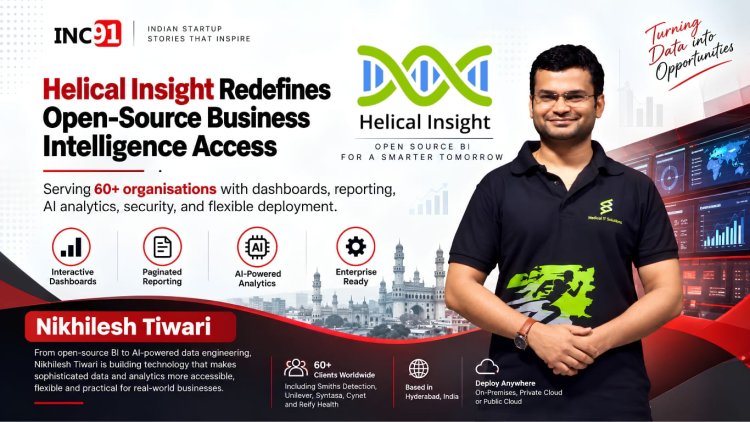
The industry calls this the open-core model, and it has funded many successful companies. Helical Insight, an open-source business intelligence platform built by Hyderabad-based Helical IT Solutions, has decided to walk away from it. The company now offers its full functional platform, including AI-powered conversational analytics, in the free Community Edition. Co-founder Nikhilesh Tiwari calls the decision the biggest turning point in the companys history.
This is the story of why a services-rooted Indian technology company made that call, what it is betting on, and what other founders can learn from it.
What everything free actually means
The claim is deliberately broad. According to the company, the Community Edition includes:
- AI-poweredconversational analytics, letting users ask questions of their data in natural language, with a bring-your-own-LLM option
- Interactivedashboards and self-service analytics, including drill-down and drill-through
- Pixel-perfect,paginated canned reports
- Embeddedanalytics and white labelling
- Multi-tenancy,row-level security, role-based security and single sign-on
- Reportscheduling and bursting, plus APIs and integrations
- Deploymenton-premises, in the cloud or in hybrid setups, including Docker and Kubernetes
Tiwaris point is that none of this is a teaser. Our Community Edition provides the same core functional capabilities rather than putting essential enterprise features behind multiple paywalls, he says.
Why abandon open-core?
The reasoning is partly philosophical and partly practical. Helical had spent years building the product and working with organisations that needed enterprise BI. Over time, Tiwari says, the team realised that the traditional open-core approach was not aligned with what we wanted to achieve.
The original motivation for Helical Insight, when it was co-founded in 2016, had been to make business intelligence accessible to organisations that could not or would not pay high licence fees. A product that becomes truly useful only after an upgrade sits awkwardly with that mission. So the team made what Tiwari describes as a significant shift in philosophy: instead of asking users to upgrade to access important capabilities, put the complete functional platform in front of everyone.
There was a market logic too. Helical had noticed that several modern open-source BI platforms had built strong communities, but that many advanced capabilities were reserved for commercial offerings. A fully featured free alternative could stand out precisely because it refused to gate features. The companys own comparison page sets Helical Insight against popular open-source tools such as Superset, Metabase, Redash and Lightdash on AI capabilities, paginated reporting, embedding, SSO, multi-tenancy, white labelling, scheduling and total cost of ownership.
How the business still makes money
Free software raises an obvious question, and the answer lies in Helicals origins. Helical IT Solutions was founded in October 2012 as a services company. It has spent more than a decade delivering implementation, customisation, migration, consulting, training and support for clients such as Fractal Analytics, Tata Communications and Technip. That experience is the commercial engine behind the free product.
The model is straightforward. Organisations can download Helical Insight from GitHub, run it on their own infrastructure and use it without a licence fee. Those that want help, whether with a complex deployment, a migration from an older reporting tool, custom development or dedicated support, can buy it from the team that builds the software. Tiwari says our business model continues to be built around enterprise support, implementation, customization, training, and related services.
It is a familiar bargain in open source, but Helicals version is stricter than most. The free edition, Tiwari says, is not designed to be a gateway to a heavily restricted paid product.
Early signals from the market
Within a month of the change, the Helical Insight repository on GitHub had crossed 1,000 stars and 700 forks. Tiwari is careful about how he reads that. These numbers are more than vanity metrics, he says; they represent developers and organisations discovering the project, evaluating the technology and choosing to keep it on their radar.
Media attention followed. Version 7.0 and the decision to make enterprise features free have been covered by MarTech Series, AI Weekly, The Executive Outlook and Open Source For You magazine. The company has also leaned into humour. One social media campaign personified the monthly BI subscription as a character called BiLL, always growing and never cheap, and announced that Helical had decided to fire him.
Stars and headlines are not revenue, and the real test will be how many organisations that adopt the free platform go on to buy support and services. But as evidence of demand for enterprise-grade BI without feature gating, the early response is a meaningful data point.
The risks of giving it all away
The strategy is not without risk. Tiwari acknowledges that building an enterprise-grade BI product in a market dominated by large platforms takes significant time and engineering effort, and that the open-source label itself can work against a company. Many buyers assume open source means basic, or that a commercial licence will eventually be required. Helical has had to earn credibility through customer implementations and continuous product development.
There are structural risks as well. A company that gives away its core product must be sure that services revenue can fund continued development. It must build a community that contributes, not only consumes. And it must keep pace with a field that has moved from traditional reporting to self-service BI, embedded analytics, cloud deployment and now AI. Tiwaris answer has been to keep expanding one unified platform rather than spinning up separate products for each wave.
Another safeguard is the customer base. Helical Insight is used by more than 60 organisations, according to Tiwaris professional profile, and the company says it works with clients ranging from startups and SMEs
to larger enterprises with complex BI requirements. Feedback from those customers, he says, has helped the team prioritise real-world problems over industry trends.
What buyers and builders gain
- Businessescan reduce BI licensing costs, avoid per-user pricing and keep more control over their data and infrastructure.
- SaaSand application builders can embed analytics in an LMS, SaaS product, fintech app or ERP without building a BI platform from scratch or buying another licence.
- Enterprisescan run analytics on-premises, in a private cloud or in a public cloud, and choose the AI model that fits their security and compliance needs.
- Developerscan inspect the source code, customise the platform and contribute back to the
For an industry accustomed to per-user pricing, the last point matters as much as the first. Open source is not only about price. It is about the ability to see, modify and own the software an organisation relies on.
Lessons for founders
For entrepreneurs, Helicals decision offers three lessons.
First, conventional business models are choices, not laws. You dont always have to follow the conventional business model, Tiwari says. The decision came with its own challenges, he adds, but it helped the company build a clear identity and connect with a community that believed in the same idea.
Second, start from a real problem. His advice is to spend time understanding customers and how they currently cope with their frustrations, because opportunities often hide in areas people have accepted as the way things are for a long time.
Third, do not wait for perfection. Build something, put it in front of real users, learn from their feedback and keep improving. The journey is rarely linear, Tiwari says, and consistency and a willingness to adapt can be worth more than having everything figured out on day one.
What comes next
Over the next five years, Tiwari wants Helical Insight to become a globally recognised free and open-source platform for BI, analytics and AI-driven data exploration, and a leading alternative to commercial BI platforms. The roadmap leans into the convergence of BI and AI: users asking follow-up questions, discovering trends, generating analyses and eventually using AI agents to assist parts of the analytics workflow.
The company also wants to expand its global presence and grow a much larger developer and user community. We dont want to simply build another BI tool, Tiwari says. The aim is to contribute to a more open analytics ecosystem, where organisations have greater control over their data, infrastructure, AI models and technology choices, and where powerful business intelligence is not restricted to those with large software budgets.
Tiwari is also a co-founder of Ask On Data, a chat-based, AI-powered data engineering tool launched in 2024, which extends the same accessibility philosophy from analytics to data pipelines.
To connect with their team :
Visit their website : https://www.helicalinsight.com
Company LinkedIn : https://www.linkedin.com/showcase/helical_insight/
Nikhilesh Tiwari's LinkedIn: https://www.linkedin.com/in/nikitiwari/
Story Featured by INC91.
What's Your Reaction?