The "Services as Software" Playbook: Inside Devcansol's Business Model Bet | Venkat Viswanathan
Venkat Viswanathan, Founder of Devcansol Private Limited, explains why the next wave of tech companies won't sell consulting hours — they'll sell systems that reconfigure themselves.
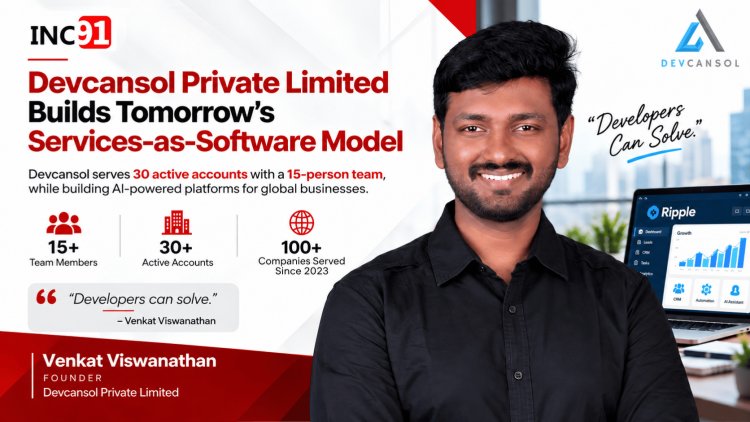
For most of the last two decades, the tech industry has sold infrastructure as a service, platforms as a service, and software as a service. Venkat Viswanathan, Founder of Devcansol Private Limited, believes the next category is the inverse of all three: services delivered as software. It's a bet he's built his company around — and one that nearly didn't survive its first real test.
From Analyst to Architect
Venkat's path into building software companies wasn't linear. He began in finance, writing valuation reports and amortization schedules for the US commercial real estate market from Chennai, before joining a risk analysis team in March 2020. The pivot came at Verumex, where his role as an analyst required translating financial reports and business requests into technical specifications for engineers. Recognizing the pattern from the inside — "I was the person consuming the data, so I knew exactly where it hurt" — he taught himself Python and SQL, and was moved onto the technical side by his mentor, Brittian Warner. He went on to build data pipelines standardizing feeds from over 120 data providers across 30-plus countries, cutting work that took business teams months down to a few clicks.
In 2023, he founded Devcansol — short for "Developers can solve" — around a specific insight: business users shouldn't need to write SQL to get an answer from their own data. An AI could do that translation instead.
Two Business Lines, One Thesis
Devcansol runs two parallel tracks. It operates as an extended technical team for software companies, largely in the US, functioning as their offshore engineering capability and often representing them directly to their own clients. It also serves as the technical partner for non-technical founders and service-business owners who have a product idea but no engineering team of their own.
Underneath both is Devcansol's own platform, Ripple — an enterprise stack (CRM, referral tracking, task and attendance management, a CMS, and a role-based AI assistant) that sits behind a client's existing website, onboardable in roughly a week. For US real estate clients specifically, Ripple also delivers rent and home-value estimators with comparable-property data and adjustable cost variables.
The Client-Concentration Risk That Almost Ended It
Devcansol's business-model insight was tested hard in 2025, when the company lost its two largest client engagements within a short window — one project reached its natural conclusion, the other ended when its founders fell out of alignment and wound the business down. Venkat was left with a full team and no engagement to run it on.
The recovery came from an unconventional deal: Venkat offered the departing founders a commission in exchange for taking over continuity of service for their clients, rather than letting those relationships lapse. It kept clients served, compensated the exiting founders for equity they were about to write off, and gave Devcansol the cash flow to retain its team through a multi-month recovery.
That inherited client base became the seed of the Ripple brand — and the near-miss forced a structural correction that now defines Devcansol's growth model: rather than scaling headcount in lockstep with client count, the company converted repeatable engagements into reusable, white-labelled platform components that can be deployed for new clients without proportional hiring. Devcansol now runs a team of fifteen against roughly thirty active accounts, having served over a hundred companies since its founding.
The Thesis Going Forward
Venkat's read on where the market is headed: AI is making the configuration, integration, and "wiring between tools" work — historically billed by the hour by consultants — something systems can increasingly do for themselves. That shift means clients get solutions that evolve with their business rather than solutions requiring a fresh project every time something changes. Ripple, he says, is Devcansol's first real proof of that model. The five-year goal is for Devcansol's own products to carry the majority of company growth, supported by — rather than replaced by — its service depth.
His counsel to founders navigating similar bets: keep a reserve, because early conviction rarely survives contact with reality unchanged; and judge partners and clients by what they do, not what they say they'll do.
About Venkat Viswanathan: Founder, Devcansol Private Limited. Website | LinkedIn | Instagram
Featured by INC91.
What's Your Reaction?