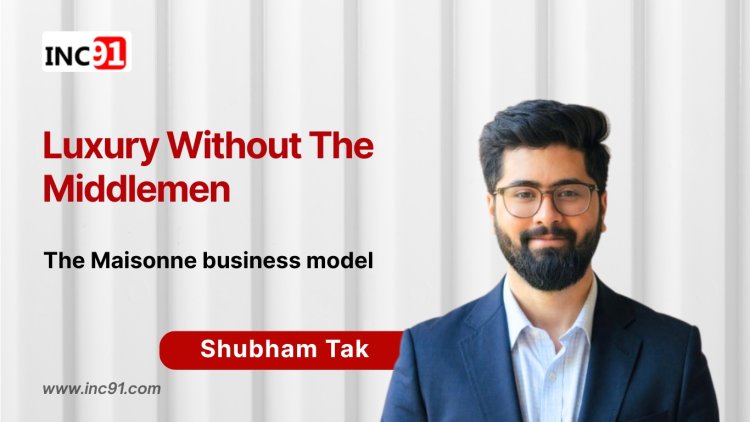
Reimagining Global Commerce: The Story of Shubham Tak and Maisonne
IIT Kanpur alumnus Shubham Tak is redefining global home décor commerce through Maisonne’s manufacturer-to-consumer model, connecting Indian craftsmanship with US markets.
Early Foundations and the IIT Discipline
For Shubham Tak, discipline came early. An alumnus of the prestigious IIT Kanpur, he describes cracking the IIT JEE as one of the first defining challenges of his life. The preparation phase shaped more than just academic excellence. It built resilience, structured thinking, and the ability to stay consistent under pressure.
During his time at IIT Kanpur, Shubham experienced two very different professional worlds. He interned at a multinational corporation and also worked with a startup. The contrast stayed with him. Large firms offered structured execution. Startups demanded ownership and speed. The combination quietly laid the groundwork for what was to come.
Post graduation, he worked with established companies and simultaneously helped smaller businesses scale operations. But entrepreneurship was never a distant thought. Coming from a business family, building something of his own felt natural. Watching IIT alumni create companies like Flipkart, Ola, InMobi, Zomato, and Urban Company strengthened that belief. If they could build at scale, so could the next generation.
That conviction became the starting point of Maisonne.
The Moment That Sparked Maisonne
Before launching a venture, Shubham wanted clarity. He began closely working with an apparel manufacturing and export company run by a relative. That exposure changed his perspective.
For the first time, he saw how global brands source products from Indian factories and sell them in international markets. He observed the full journey of a product from a manufacturing unit in India to store shelves in the United States.
One question refused to leave his mind:
If the product is made at the factory, why is the factory so disconnected from the final customer?
He noticed the number of intermediaries between manufacturer and consumer. Exporters, importers, wholesalers, distributors, retailers. Each layer added cost. The product remained the same, but the price multiplied.
From a systems point of view, it felt inefficient. From an entrepreneurial point of view, it felt like an opportunity.
That insight became the seed for Maisonne, a US based luxury home and décor e-commerce brand built on a manufacturer to consumer model.
Identifying the Structural Gap
The biggest gap Shubham noticed was not about product quality. It was about structure.
A typical global supply chain looked like this:
Manufacturer → Exporter/Importer → Wholesaler → Distributor → Retailer → Consumer
Every additional step increased margins, logistics expenses, and overhead costs. The final buyer paid significantly more than the production cost justified.
Meanwhile, India remained one of the largest exporters of home textiles and décor products to the US. Yet there were no strong global home brands from India operating directly on a manufacturer to consumer model.
That disconnect shaped Maisonne’s core idea. Remove unnecessary middle layers. Build a brand directly connected to manufacturers. Keep inventory lean. Stay closer to production. Respond faster to demand.
The name Maisonne, derived from a French word associated with household and family, reflects the brand’s intent to create thoughtfully designed living spaces while restructuring how global home products are delivered.
Building a Luxury Brand with Smarter Economics
Maisonne operates as a direct to consumer luxury home and décor e-commerce platform. Its categories include bedsheets, rugs, cushions, home fragrances, décor accents, lighting, and furniture. The vision is not to sell standalone items but to create a cohesive premium experience from floor to wall.
The company partners with manufacturers & brands across India, from Coimbatore to Rajasthan, Delhi, Panipat, and Noida. Many of these brands have been featured in platforms such as Elle Decor, Vogue, Architectural Digest and even appeared on Shark Tank India.
The supply chain architecture is where Maisonne stands apart.
When a customer places an order, it is fulfilled from the India warehouse and shipped via air freight to the United States. Import clearance happens in transit. Once landed, the order is automatically assigned to a last mile delivery partner. Delivery timelines range between five to seven days, comparable to many US based D2C brands.
By eliminating traditional intermediaries, Maisonne maintains luxury positioning while offering more efficient pricing. It is not a discount brand. It is a premium brand with redesigned economics.
Navigating Early Challenges
Aligning premium manufacturing with an agile D2C model was not simple. Many high end manufacturers operate with larger minimum order quantities. For an early stage brand, that creates inventory pressure.
Instead of pushing heavy production runs, the team began working with in house designs and existing inventories already available with manufacturers. This allowed them to maintain quality while keeping operations lean.
Export compliance added another layer of complexity. Inventory sourced into the Delhi warehouse needed to move within defined timelines to avoid regulatory inefficiencies. This forced the team to think differently about logistics.
Dubai emerged as a strategic option due to its geographic positioning and flight connectivity to the US, UK, Europe, and GCC markets. It also provides flexibility to consolidate inventory from countries like India and Vietnam.
Technology plays a strong role in execution. An internal AI engine determines the most efficient US port of entry based on customer location. Routing instructions are automatically communicated to the warehouse team, improving dispatch speed and reducing delivery timelines.
For Shubham, building Maisonne has meant redesigning cross border commerce layer by layer.
The Road Ahead
The long term vision is clear. Make the manufacturer to consumer model globally scalable and operationally strong.
Maisonne plans to develop distributed warehouses across India’s key manufacturing clusters, placing inventory closer to suppliers. The company also intends to strengthen its Dubai warehousing strategy to serve multiple global markets beyond the US.
On the product side, the current focus is on lightweight categories suited for air freight. Over the next phase, the brand plans to enter heavier categories like large furniture and premium rugs through ocean freight logistics.
There is also a B2B opportunity on the horizon. Partnerships with interior designers, architects, and hospitality projects in the US could expand Maisonne beyond retail consumers into larger format supply chains.
Technology remains central to this expansion. The team is investing in AI driven routing, automated content generation, and intelligent search systems that allow customers to describe what they want in natural language and discover relevant products effortlessly.
Lessons for Aspiring Entrepreneurs
For Shubham, passion is non-negotiable. If money is the only motivation, the journey becomes difficult to sustain.
He believes that the only real loss in entrepreneurship is quitting. Survival builds compounding advantage.
His principles are simple and practical:
- Customer obsession. Start with the customer and work backwards.
- Long term ownership. Think beyond short term validation.
- Invent and simplify. Fix broken systems instead of accepting them.
- Operational excellence with action. Speed matters. Learn fast and iterate.
Entrepreneurship, he says, is rarely glamorous in the beginning. It is operational, uncertain, and demanding. But for those willing to stay consistent, the rewards go beyond financial returns. They reshape industries.
Connect with Shubham Tak
To follow Shubham’s journey and connect with him:
LinkedIn: https://www.linkedin.com/in/shubham-tak-8a5332128
Instagram: https://www.instagram.com/shub_ham_tak/
As Maisonne continues to bridge Indian craftsmanship with global markets, it represents more than a luxury home brand. It signals a shift in how cross border commerce can be built with clarity, efficiency, and long term intent.
What's Your Reaction?