How Two Gujarati Brothers Built Hamercop into a 10-Lakh-Order Menswear Brand Without External Funding
Discover how Gujarati brothers Anil and Tushar Mendpara built Hamercop into a 10-lakh-order menswear brand without external funding.
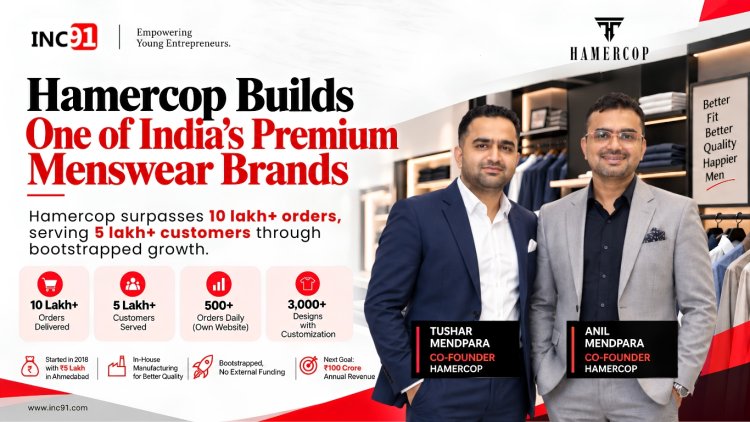
Entrepreneurship does not always begin with a business degree, a large investment, or a carefully designed five-year plan. Sometimes, it begins with a problem that refuses to go away. For Anil and his brother Tushar Mendpara, co-founders of Hamercop, that problem was surprisingly simple: finding a shirt that actually fit well.
A postgraduate in Pharmacy from Ahmedabad, Anil did not come from a traditional fashion or business background. His father worked as a diamond worker, and Anil completed his education in Gujarati medium before earning his Master's degree in Pharmacy. But after graduation, finding the right employment opportunity proved difficult. His entrepreneurial journey would eventually take him through a medical store, cosmetics sales on Amazon, and a garment jobwork business before he found the idea that would become Hamercop together with his brother Tushar Mendpara.
Founded in 2018, Hamercop emerged from the intersection of two frustrations. One was personal: Anil and Tushar were tired of ordering shirts from major online marketplaces only to find that the fit did not match expectations or that the actual product looked different from what was presented online. The second was professional: their garment jobwork business offered inconsistent and irregular income, making it difficult to build a predictable future.
Instead of simply accepting either problem, the brothers decided to solve both.
They began building Hamercop around a straightforward proposition: menswear should not force customers to choose between convenience and fit. Ready-to-wear clothing offered convenience, while custom tailoring offered personalization, but the two rarely existed together in an accessible format. Hamercop was created to bring those experiences under one roof.
The company today offers premium menswear including shirts, T-shirts, trousers and everyday essentials, with shirts remaining at the heart of the business. Customers can choose from more than 3,000+ designs, with ready-to-wear shirts available across seven sizes and in both full-sleeve and half-sleeve formats. Alongside ready-to-wear products, Hamercop provides customization options around fit, fabric and design.
For Anil and Tushar, however, customization was only one part of the opportunity. Fabric quality was equally important.
The brand began focusing on premium materials, including Giza cotton, at price points intended to remain accessible to regular customers. This approach required greater control over production, which eventually led to one of the most important decisions in Hamercop's journey: bringing manufacturing in-house.
Building its own manufacturing capability changed the economics and operations of the business. Instead of relying entirely on external vendors, Hamercop could have greater control over production timelines, quality, pricing and product development. It also gave the company greater flexibility to combine customization with ready-to-wear fashion.
That manufacturing decision became a foundation for the company's subsequent growth.
Yet the road to scale was far from straightforward. Anil and Tushar chose to build Hamercop without external funding, meaning every major decision had to be balanced against cash flow. Premium fabrics, manufacturing costs and digital advertising all competed for the same limited resources. Scaling aggressively was not always an option.
The challenge became even more apparent when Hamercop attempted to expand into the United States through Hamercop Global in 2023. The ambition was international, but the available capital could not comfortably support scaling both India and the US at the same time. Rather than putting the core Indian business at risk, Anil and Tushar made the difficult decision to shut down the US operation and concentrate on India.
For bootstrapped founders, protecting the core business can sometimes be more important than chasing every available opportunity.
Anil and Tushar's entrepreneurial journey also included attempts to raise the company's profile through Shark Tank India. They reached the audition stage in both Season 3 and Season 4 but did not proceed further. According to Anil, the fashion category had already seen significant representation during those seasons. Regardless, the experience became another chapter in a journey where external funding never became the foundation of Hamercop's growth.
Instead, the brothers learned by doing.
Without formal mentorship in fashion, they taught themselves digital marketing, Meta advertising, SEO, production and other aspects of running a modern D2C company. Their experience in manufacturing gave them operational exposure, while their customer-first approach helped shape the product.
Then came one of the most difficult moments in the company's history.
In 2021, Hamercop's website, which was running on Magento, was completely deleted because of an error. Along with the website, the company lost its customer data. For an online-first business, such an incident could have had devastating consequences.
Instead of allowing the setback to stop the company, the brothers rebuilt the website on Shopify. Hamercop was back online within five days.
The incident became more than a technical crisis. It reinforced a philosophy that had already been developing within the company: move quickly, protect the business, and focus on what can be controlled.
That mindset became particularly important during Hamercop's early years. Anil and Tushar recall that the first two years were extremely difficult, with the company failing to cross even 1,000 cumulative orders. The challenges were compounded by Covid, which disrupted businesses across the country.
There were no shortcuts to the next stage of growth. Hamercop continued refining its products, listening to customers, controlling manufacturing costs and reinvesting profits. Rather than pursuing growth at any cost, the brothers concentrated on building a business that could sustain itself.
That discipline has now translated into a very different scale.
Hamercop says it has delivered more than 10 lakh+ orders and served more than 5 lakh+ customers. The company currently receives more than 500+ orders a day through its own website, according to Anil. The journey from fewer than 1,000+ orders during its first two years to this level of customer activity represents the gradual compounding of product, manufacturing and customer experience decisions.
At the center of that growth is a simple observation: men may want the convenience of online shopping, but they do not necessarily want to compromise on fit.
Hamercop's model attempts to address that gap by combining ready-to-wear convenience with customization, while maintaining control over manufacturing. In a market increasingly shaped by D2C brands, personalization and digital discovery, the company is betting that manufacturing control can become a competitive advantage rather than simply an operational necessity.
Its ambitions now extend well beyond shirts.
Over the next five years, Anil and Tushar want Hamercop to become one of India's leading premium D2C menswear brands, with a target of crossing ₹100 crore in annual revenue. The roadmap includes expanding beyond shirts, strengthening the company's offline presence and eventually relaunching Hamercop Global in the United States with adequate funding and infrastructure.
Importantly, the co-founders say the company intends to maintain its bootstrapped discipline while pursuing this growth. For Hamercop, the objective is not growth at any cost, but sustainable expansion built around manufacturing, product quality and customer trust.
Anil and Tushar's story is ultimately less about fashion and more about persistence. A Pharmacy graduate from Gujarati-medium schooling did not enter the apparel industry with conventional credentials, a large investor behind them, or a ready-made playbook. They entered because they experienced a customer problem and believed it could be solved differently.
The ₹5 lakh with which they started Hamercop was not a massive war chest. What followed was years of experimentation, manufacturing challenges, technology failures, Covid disruptions, failed expansion attempts and repeated learning.
Yet the business kept moving.
For aspiring entrepreneurs, Anil and Tushar's central lesson is uncomplicated: start with what you have. Do not wait for perfect funding, perfect timing or perfect expertise. Stay close to customers, protect cash flow, maintain product quality and treat setbacks as information rather than endpoints.
Hamercop's journey shows what can happen when founders stay with a problem long enough to understand it deeply. What began with two brothers' frustration over ill-fitting shirts has evolved into a menswear business with more than 10 lakh+ orders delivered and an ambition to build a much larger Indian brand.
The next chapter will involve new categories, offline expansion and another attempt at international markets. But the foundation remains the same as it was in 2018: identify a real customer problem, build the capability to solve it, and keep improving until the market begins to notice.
Website: hamercop.com
Instagram: @hamercop_shirts
What's Your Reaction?