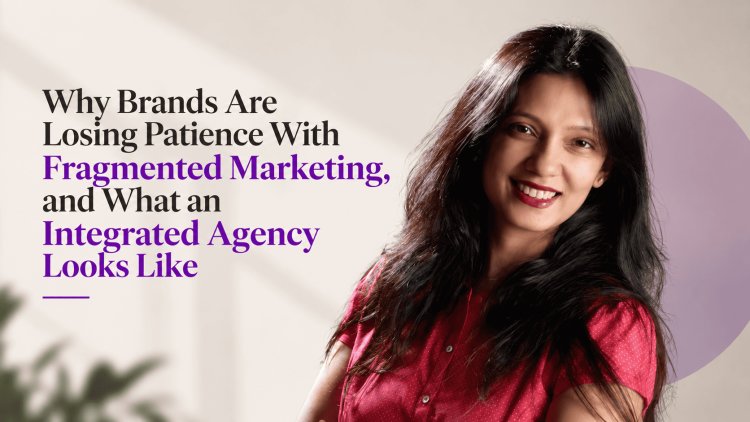
Why Brands Are Losing Patience With Fragmented Marketing, and What an Integrated Agency Looks Like
Madhulika Joshi, founder of Martist Services, on the cost of running strategy, creative, digital and PR through separate partners, and how a strategy-led integrated model changes the conversation between a brand and its agency.
Ask a marketing head how many agencies the brand works with and the answer is rarely one. A firm handles strategy. Another runs social media. A third produces creative, a fourth manages digital, and PR, content and campaigns sit with whoever won the last pitch. Each partner does competent work. The trouble is that nobody is responsible for the whole picture.
Madhulika Joshi has watched this pattern for more than twenty years, first as a brand and marketing professional in hospitality, lifestyle, retail and wellness, and now as founder, CEO and Chief Creative Officer of Martist Services Pvt. Ltd., an integrated marketing agency. Her view is that fragmentation has become one of the quiet drains on marketing budgets, and that the fix starts with how agencies define their own job.
How Marketing Became Fragmented
Nobody planned it. As channels multiplied, brands added specialists. A social media agency made sense once social media became a full-time function. Performance marketing needed its own team. Content, influencers and PR each grew into separate disciplines with their own vendors, tools and reporting lines.
Joshi saw the result from the client side. “One of the biggest gaps I noticed was that marketing was often becoming fragmented,” she says. Brands worked with different partners for strategy, social, creative, digital, content, PR and campaigns, but the thinking behind each was not always connected.
The effects are familiar to anyone who has sat through a review meeting. The social team adopts a tone the campaign team never approved. The performance team optimises for clicks on a message the brand strategy has already moved past. A PR push and a festive campaign land in the same fortnight without reference to each other. Customers do not see separate vendors. They see one brand behaving inconsistently.
When Agencies Became Vendors
A second shift ran alongside the first. Many agencies were increasingly treated as execution partners, hired to deliver a presentation, a film or a month of posts against a brief written somewhere else. The strategic discussion happened inside the brand, and the agency received the output.
Joshi thinks that arrangement short-changes both sides. Brands lose the outside view an experienced agency can offer. Agencies lose the context that makes the work sharper. What brands really wanted, she says, was a partner that understood the business problem before starting on the communication.
The related gap she noticed was depth of understanding. At Martist, the brief is the starting point rather than the whole assignment. The team looks at the commercial objective, the consumer, the category and what the brand needs to achieve, then works back to the communication.
What an Integrated Model Means in Practice
Integrated is one of the most overused words in the agency business, so it helps to be specific. At Martist it means strategy, creativity, content and execution sit inside one connected process instead of being passed between teams that never meet. The company does not look at services in isolation. It begins with the business objective, studies the audience and the brand context, and then designs the communication around them.
The services cover brand strategy, creative communication, social media, digital and performance marketing, content, campaigns, influencer engagement, PR support, design and visual storytelling. Out-of-home solutions and brand workshops also appear on the company's website. Several sub-verticals within Martist handle different parts of that range, so a client can use one or several without managing a separate relationship for each.
The test of integration is simple. When a brand changes its positioning, how many people need to be briefed separately? In an integrated setup, the answer should be one team.
Content Has Multiplied, and So Has the Pressure on Consistency
Part of the reason integration matters now is the sheer volume of content brands are expected to produce. Joshi remembers a time when much of a brand's voice lived in a slogan or a tagline. Amul's witty advertisements are the example she returns to. A single line, a clever turn, and the job was done.
That world has gone. Content now runs across digital platforms, traditional media and everything in between, and each channel needs its own treatment. Video has taken centre stage in recent years and has overtaken written content in popularity, she says. Relatability decides whether any of it works. Content that resonates with its audience is the content most likely to succeed.
More formats and more channels raise the stakes for coherence. A brand can be witty on one platform, formal on another and absent on a third, and the audience will notice. Telling one story consistently across touchpoints is harder when five agencies each hold a piece of it.
Digital Fatigue and the Case for Fewer, Better Messages
Looking three to five years ahead, Joshi expects artificial intelligence to become more central to how companies, creative agencies and content creators work, allowing marketing that is more personalised and more efficient. She also sees a counter-current. Consumers, herself included, feel saturated by content and advertising. Some will look for privacy and a break from the constant stream. Nostalgia marketing, like the return of 1990s-era content, may grow as people look back at simpler times.
For brands, the implication is that more output will not solve the problem. A tired audience rewards messages that are clear, relevant and tied to what the brand actually stands for. “For us, the goal is not simply visibility. It is to create strategy-led storytelling that builds relevance, connection and long-term brand value,” Joshi says.
Cross-Category Experience as a Working Advantage
Martist has worked across hospitality, retail, wellness, lifestyle, travel and other consumer-facing sectors. Joshi counts that breadth among the agency's strongest differentiators, because ideas travel. A loyalty mechanic from retail may suit a wellness brand. A storytelling approach built for a hotel may solve a problem for a travel company. An agency that knows only one sector tends to repeat what the sector already does.
She also believes marketers carry a duty to educate the people they work for. That includes explaining that return on investment is not only about immediate monetary gains. Reach and engagement count too. An agency that sets those expectations early gives both sides a fairer basis for judging the work.
Questions Brands Can Ask Before Choosing an Agency Partner
Drawing on Joshi's approach, a few questions help separate an integrated agency from a collection of services.
- Does the agency ask about the commercial objective before it discusses deliverables?
- Who owns the connection between strategy, creative, content and digital on this account?
- Has the team worked outside our category, and what did it carry over?
- Will the agency challenge the brief when the brief looks wrong?
- How will success be measured beyond immediate sales?
None of these require a large agency. They require a team that treats strategy as part of the work and not a preface to it.
A View From Someone Who Has Sat on Both Sides
Joshi's opinions carry weight partly because of where she formed them. She began her career in 1999 at Leela Ventures, part of the Leela Group of Hotels, and later worked with brands including Pidilite Industries and Fevicol, where she helped launch Hobby Ideas, an arts and crafts initiative. In those roles she hired agencies, briefed them and judged their output.
Founding Martist asked for a different set of skills. In a company where everything had once come ready-made, she had to build HR practices, employer branding and internal processes from scratch. It also shaped how she runs the agency. She has become more selective about the work Martist takes on, put stronger processes in place and focused on clients who value strategic thinking over pure execution.
Where Martist Is Heading
Over the next five years, Joshi wants Martist to be known as an integrated, strategy-led marketing partner with strong storytelling and sharper thinking. That means a more selective portfolio of high-value clients, deeper capabilities and more proprietary thinking. She also wants the company to mentor and groom young professionals entering the industry, giving them real-world exposure.
The measure she uses is not headcount or billing. It is relevance, and the value created for clients, teams and the wider marketing community.
As the company moves toward fewer transactional relationships and stronger partnerships, the integrated model is the means. The aim is for clients to ask the agency what it thinks they should do, and not only whether it can produce a given piece of work.
Frequently Asked Questions
What is an integrated marketing agency?
An integrated marketing agency handles strategy, creative, content, digital, social and PR as one connected process instead of separate engagements, so the brand's message stays consistent across channels.
Why do brands struggle with multiple agencies?
When different partners handle different functions, the thinking behind each can drift apart. Brands often end up managing the connections themselves, and customers see inconsistent messaging.
What does Martist Services offer?
Brand strategy, creative communication, social media, digital and performance marketing, content, campaigns, influencer engagement, PR support, design and visual storytelling.
About Madhulika Joshi
Founder, CEO & Chief Creative Officer, Martist Services Pvt. Ltd. Website | LinkedIn | Instagram: madhulika.inspire
Featured by INC91.
What's Your Reaction?